We first went off to the Minamata Disease Memorial Monument which was dedicated to the people who died because of the disease. I felt very sad that they had to die for something which they did not deserve. Next, we were off to the Minamata disease museum which was full of information about the Minamata disease such as the history of it and how the Chisso Company did not stop the flow of mercury even when they knew they could. I learned a lot about the disease there. There was also a talk by a historian about the disease. Lastly, we went to the Eco Net where I learned that using the synthetic soap could pollute fish and kill them. So we can also save the environment by using natural soap. We also made soap with our groups and I felt very happy to do that as we used teamwork to get the job completed. Today was fun but I am sure that there was more to come.
Ryan
12:38 AM |
Category: |
We went to the Minamata Memorial Monument. We saw many sea creature clay art as decoration, around the tablet. The scenery there was very beautiful. The tour guide gave a detailed explanation of the history behind the tablet. It was very meaningful as it enabled us to understand more about the tablet. Next, we went to the Minamata Disease Musuem. As the tour guide brought us around, she briefed us more on the Minamata disease patients. She brought us to listen to the family member of the Minamata disease patient to let us know how serious the disease is and from there I learnt that we should be more considerate and make use of the 3 Rs - Reduce, Recycle and Reuse. After that, we went soap making. It was the first time I know that chemical detergent can kill a fish's life. It was my first time to use cooking oil to make soap.
Stella
12:35 AM |
Category: |
During the visit to Minamata diseases , we have learn a lot about the Minamata disease , e.g. how it occurred due to the disposal of methyl mercury into the sea by the company Chisso, how it has affect the people lives and the tragic happening to the people who are affected it. We heard from a person who is a victim as she lost two family members due to the Minamata disease. She spoke out her thought towards this issue and also her feelings against Chisso doings. After visiting the museum, we went on to the soap factory. The guide explained to us how to recycle used oil to other useful items which are good to the environment. We also did some hands on activity on how to make soap with just minimum ingredient.
Terence
12:30 AM |
Category: |
We went to Minamata disease museum to learn about the facts and information of Minamata disease. The museum showed us all the scary pictures of the Minamata disease patients. One of the pictures was the patients scratching the wall. I learnt how Minamata disease came about. It was because of the Chisso factory discharging their harmful waste into the sea. Although they know it will affect the marine lives, they still discharged them into the sea. THEY ARE BEING VERY IRRESPONSIBLE, SELFISH AND INCONSIDERATE! As the mercury went into the sea, the fishes will 'drink up' the water. Then they will be polluted and the human beings will eat the polluted fishes. The Minamata disease came about like this! Next, we proceeded to a room and there was a lady whom her grandparents and parents contracted this disease and died quite early. I think she was very brave because although she lost her loved ones, she still shared with us her tragic experience.
Next we headed to make the soap. I did not know that soap is made of oil and Ithink they are being very environmental friendly.
12:24 AM |
Category: |
This morning, we had our breakfast in the restaurant located near the hotel lobby. Then, we moved on to Minamata, where we went to Minamata Memorial Centre first. It was where they would commemorate the first official recognition of the Minamata Disease and the death caused by it. Thereafter, we went for our lunch then before going to the Minamata Diesease Information Centre where there is a lady whose family is invovled with the Minamata Diesease. She said that her Father and Grandfather died due to the diesease and she has mixed feelings. The diesease was officially found on May 1, 1956.
Then, we went to the Eco Net – Soap making. We learnt how they made soap by using recycled oil. We then ended the day by going back to another hotel.
Yan Li
12:24 AM |
Category: |
We headed straight to the next city area that is Minamata. The ride there was rather long and we took the opportunity to take a nap till we reached Minamata. We were greeted by the local tour guide at the Minamata City Hall. Then, we took a short stroll along the recreational park of Minamata. The place was calm and breezy as the sun rose in a pool of crimson gold. We were told that the place was buid over the toxic waste of Mercury. We visited the memorial and took some pictures. We made our way to the Minamata Municipal Museum to enquire more on the cause of the disease that is mercury poisoning. A victim of the disease was kind enough to share her heart warming experience. We felt sympathetic towards her family as she lost her father and grandfather due to the Minamata disease. We learned that the disease was transmitted via the consumption of fish in the mercury contaminated rivers. Next we headed to the mini soap factory. We had fun making soap out of baking soda and used oil. It requires a lot of patience and teamwork to stir the two ingredients. In the end, our hard efforts finally paid off as each of us received a recycled soap product as a token of appreciation…
Zaki
11:35 PM |
Category: |
Today we learn about the Minamata disease, the first pollution related sickness. The problem was created by a chemical company Chisso which discharged chemical affluent that contained methyl mercury. The people ate fishes caught from the polluted sea water and fell sick. The doctors could not identify the cause of the illness and as more and more people fell sick, people become more and more fearful and anxiety built up among the people. Eventually after research and experimentation with samples collected from different sources, they found out that it was due to the polluted seawater.
What was most appalling was the fact that the company already knew that chemical affluent discharged caused the people to fall sick and yet they still continued to pour tons and tons of toxins into the sea disregarding the health of people. People who were affected by the disease often have uncontrolled convulsion, slur of speech and difficulty in walking. Other than affecting the health of people, this also created a lot of economical and social problems. Many people's livelihoods were affected. Many of them were fishermen and they were not able to catch fishes nor sell the fishes that they had caught. They also faced discrimination from other people as some believed that this was an infectious disease. The irresponsible act from the company resulted in many adverse effects to people. Till this date the issue has not been completely resolved. The company had stopped the production of these harmful chemicals.
The seawater was cleaned and the Minamata bay reclaimed so as to bury the sludge which was accumulated from 30 years of discharge. The sludge was merely buried underground waiting for another round of disaster to happen? Only time can tell. The only blessing in disguise is that this incident had taught people to become more aware of the environment and the need to take good care of the environment that they live in. For instance, they would slot their waste into 22 different recyclable categories and the use of environmentally friendly soap. Hope their effort would spread and influence the people from the rest of the world to follow suit, to take the first step to protecting our ONLY EARTH…
Ms Fu Shin Hui
11:34 PM |
Category: |
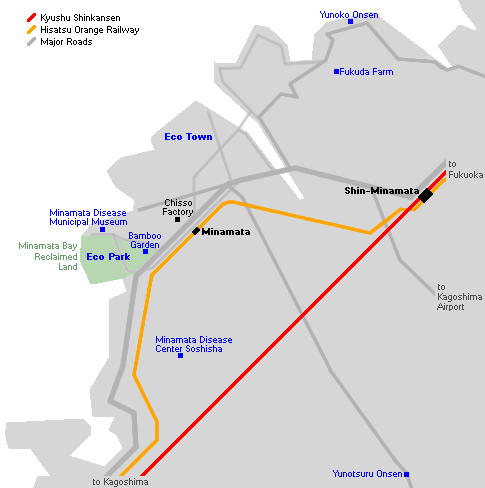
(1) Travel from Kumamoto to Minamata
(2) Minamata Memorial Monument at Minamata Bay
(3) Lunch at Fukuka Farm
(4) Minamata Disease Municipal Musuem and National Minamata Disease Information Centre - Lesson on Minamata Disease
(5) Eco Net - soap making (DIY) using recycled materials
(6) Check in Yunoko San Kaikan Ryokan Inn
(7) Dinner and 1 night stay at Yunoko San Kaikan Ryokan Inn

(Map source:
http://www.japan-guide.com/g5/4526_01.gif)
11:19 PM |
Category: |
Chatting on the handphone today with my previous host family, Mrs Kyoko. I am very gleeful today because her family always made me feels at home when I am in Japan. By the way, their home. Itami city is three hours drive from Kyushu. Back to my trip in Kyushu. One leg of our journey in Kyushu, Japan was by bus. That portion of the trip really opened my eyes and new appreciation for the power of nature. The highway was peppered with beautiful roadcuts where mountain and hill were blasted and chopped away to create this thoroughfare. For a little while at least, the shifting of the scene from rock to trees to field occupied my eyes and brain. There was something almost exciting about not knowing what would next be coming into view. I also took in the lesson I'd learned from this bus ride: always keep at least one eye on the window. If you don't, you'll miss something. And you'll wind up being a lot poorer if you do miss what's out there waiting to be seen. It was their kindness and love for their own culture and traditions made me realize what I really love about Japan.The Japanese are warm-hearted people, always ready to help and aware that foreigners have language and navigating troubles.
Today's learning journey was a fun-filled and exhausting one. From today's experience I learnt that shrines in Japan brought about great history .Dazaifu Tenmangu is a shrine built over the grave of Michizane Sugawara venerated by the Japanese throughout the country as the Tenman-Tenjin (the deified spirit of Michizane), or the God of literature or calligraphy. Our resourceful tour guide explained that Michizane, who had been a high-ranking government officer, was demoted because of the slander and political chicanery of his rivals, the Fujiwara clan.We were told that he died in 903 at the age of 59.
His funeral procession was a melancholy occasion, attended only by his faithful follower Yasuyuki Umasake and a few neighbors. The coffin was carried on a cow carriage led by Yasuyuki, according to the legend the ox suddenly came to a halt and refused to budge despite threats and entreaties. A replica of the ox still remains today and it is found at the the entrance of the shrine to commemorate the legendary ox. The burial therefore took place on the spot, and this became the site of the Tenmangu's main shrine visited today by so many admirers. Michizane is celebrated as a man, pure in heart and deed, and after his death he was deified and worshipped as a God. The wishing well in the shrine caught our eyes and we were encouraged to make a wish. We took turns to throw coins in the well and prayed for the well-being of others and in education.
After making our wishes, we made our way to the Kumamoto Food Pal centre to have our scrumptious lunch (Hirugohan). The place was picturesque and the whole landscape was filled with colourful carnations. We had our lunch in the garden and soon it was time to visit the biscuit factory. The mini factory was fascinating and a wide variety of of assorted biscuit were sold at a discount for us students. We saw how the biscuits were made and many of us were convinced how fresh these biscuits were. My friends and I took the opportunity to taste the mouth-watery muffins and cakes. The muffins were moist on the inside and crunchy outside. We bought biscuits and made our way to the next destnation, the Kumamoto castle.
Upon reaching the beautiful castle, we were seperated into two smaller groups for better guide explanation. Kumamoto Castle was built by samurai lord Kiyomasa Kato between 1601 and 1607. He was known as a ferocious warrior under first Toyotomi Hideyoshi and later Ieyasu Tokugawa, Japan's first shogun at the start of the reclusive Edo Period. For his fealty, Kato was rewarded with sizable property in Kumamoto, in those days called Higo, and from Kyushu he led Japanese forces on military expeditions into Korea. After being recalled from Korea, he began constructing Kumamoto Castle in the year after the famous battle of Sekigahara. Our local tourguide was indeed very clear in explaining the history of the castle. We had to climb flight of stairs to reach the peak of the fotress. Once we reached the peak, we were welcomed by the gentle summer breeze that brought smiles across our exhausted faces. We took photos and sat down to take a break. The mood was set for and enjoyable day ahead…
Zaki
11:12 PM |
Category: |
Today, we visited the Dazaifu Tenmangustrine built over the grave of Michizane. From this visit, I learnt the importance of the history of Japan. I also learnt to appreciate the culture and to be forgiving to the people who try to slender us. However, we should be persevering and not give up when things go wrong. As Michizane, who had been one of the most high ranking officer was demoted because of slender from the political rivals. However, he persevered and continued in his studies and never hated the people who slandered him. I also think that the reason that the school brought us to this place is because they wanted to experience the Japanese culture and learn the essence of the Japanese attitude.
The next stop that we visited is the cookie factory cum lunch stop. I think the reason why the school wanted us to visit this place is because they wanted us to understand how traditional Japanese food is made and how we need to treasure our food.
Next, we visited the Kumamoto castle where we also learnt about the Japanese tradition and culture. The reason that I think that the school wanted us to visit this castle is because they wanted us to know the way of living of the rich and famous in Japan.
Rachel
11:10 PM |
Category: |